What Breaks First
- Approval chains slow machine-speed execution.
- Real-time decisions overload batch-era governance.
- Local optimization increases enterprise-wide friction.
- Security frameworks cannot interpret intent at machine speed.
If your enterprise feels slower despite more technology—even when strategy is sound and AI investment is accelerating—the enterprise operating system is usually the constraint. Most enterprises still operate on systems designed for human coordination. As AI and autonomy begin participating directly in execution, those systems start producing slower decisions, rising operating complexity, and instability that eventually shows up in margin pressure, higher cost-to-serve, and earnings volatility.
Xcelerate Innovation helps CEOs & Boards rewire the enterprise operating system so autonomy scales without eroding margin or control.
Autonomy changes how enterprises execute. The enterprise operating system must change with it.
Enterprises built for human coordination rely on approvals, handoffs, and escalation to maintain control. Autonomous execution requires control to be explicit. Without structural governance, autonomy introduces instability that eventually reaches earnings.
Most transformation programs upgrade tools while the enterprise operating system remains fragmented. When autonomy scales, fragmentation turns into volatility. Capital goes into capability — without control — and the impact shows up later in margin, cost-to-serve, and risk exposure.
It is from human coordination to policy-governed execution. Enterprises built for human coordination struggle when machine-speed execution enters core operations.
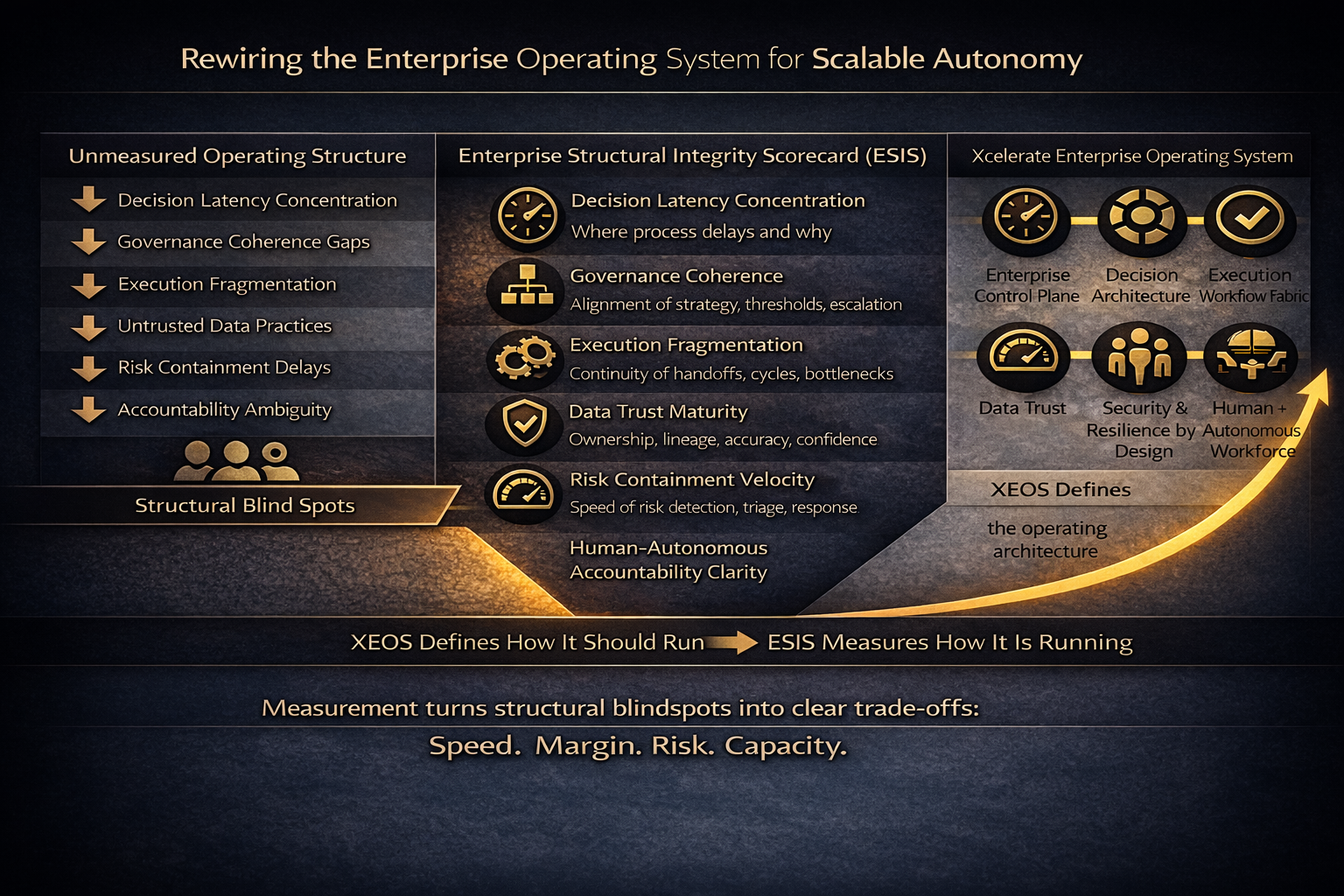
XEOS (Xcelerate Enterprise Operating System) is the operating architecture that allows enterprises to scale autonomy without introducing instability into margin, cost-to-serve, or earnings performance.
XEOS defines how enterprise execution operates when decisions, workflows, and controls increasingly occur at machine speed.
Enterprises historically operated through three layers of control: strategy, operations, and governance. As automation, AI, and autonomy enter core operations, a fourth layer becomes necessary.
That layer is the enterprise operating system — the structure that determines how decisions, workflows, control signals, and accountability operate as execution increasingly moves at machine speed.
XEOS is the operating architecture for that layer.
Many enterprises are investing in transformation, automation, and AI, yet performance still feels heavier than it should. Execution slows down, coordination cost rises, headcount does not come down as expected, and too many initiatives fail to deliver enough value after the pilot stage.
XEOS is designed for that problem. It is the operating architecture used to identify where the enterprise is structurally slowing itself down and to establish the control, decision rights, and execution discipline required for autonomy to improve performance instead of increasing instability.
In practical terms, XEOS helps leadership answer questions like:
Identifies where execution instability is building before it shows up in earnings variance, missed expectations, or leadership surprises.
Exposes where coordination cost, rework, exception handling, and fragmented execution are preventing margin improvement from actually reaching the P&L.
Clarifies which transformation, automation, and AI investments are compounding enterprise performance — and which ones are diluting it.
Shows where decision latency, workflow seams, and fragmented authority are preventing the enterprise from moving at market speed.
Makes hidden execution risk visible before it becomes a governance issue, a regulatory issue, or a board-level concern.
Establishes explicit control signals so autonomy improves performance instead of introducing instability, blind spots, and unmanaged exposure.
XEOS organizes enterprise execution into six control domains required to scale autonomy without introducing instability into earnings, margin, or governance.
Operating Model Readiness (Mandated Entry Phase). Before autonomy expands further, we establish baseline execution signals, clarify decision rights, and define guardrails. Only then is rewiring sequenced.
Enterprise Visibility
Continuously monitors execution health — friction, throughput, exception load, and emerging risk — so leadership can see where autonomy is improving performance and where it is creating instability.
CEO value: Earlier intervention. Fewer surprises in operating performance.
Decision Authority & Escalation
Defines decision rights, confidence thresholds, escalation paths, and human override so autonomy operates within explicit leadership control.
Board value: Clear accountability and defensible governance.
Enterprise Execution Coordination
Aligns strategy to execution by coordinating workflows across functions, systems, and autonomous agents.
Operator value: Fewer handoffs. Measurable cycle-time compression.
Decision-Grade Data
Defines ownership, lineage, shared definitions, and quality gates so enterprise decisions are based on trusted signals.
CEO value: Higher confidence in capital allocation and operating metrics.
Autonomy-Scale Risk Containment
Establishes controls suited for machine-speed operations with auditability, containment, and recovery built into execution.
Board value: Reduced blast radius and faster recovery.
Accountability in Hybrid Execution
Defines how human judgment, exception handling, and accountability evolve as autonomous agents take on more execution.
CEO value: Lower coordination cost as scale increases.
Autonomy rarely fails because of technology. It fails because operating control is not measured. The Enterprise Structural Integrity Scorecard (ESIS) is a CEO-readable measurement standard that quantifies execution fitness before — and while — autonomy scales.
Together they create the operating architecture, measurement discipline, and feedback loop required to scale autonomy without losing control.
ESIS quantifies execution risk and value-at-risk as autonomy scales. It allows leadership to see structural weakness early enough to intervene before volatility reaches earnings, governance, or regulatory attention.
Measurement converts operating debate into explicit trade-offs across speed, margin, risk, and capacity.
ESIS converts operating debate into measurable signals across speed, margin, risk, and capacity.
ESIS measures six structural signals that indicate whether enterprise execution is operating with control or quietly degrading as scale increases.
Where the enterprise slows down
Measures where decisions accumulate delay across approvals, escalations, and workflow handoffs.
CEO signal: strategy is clear but execution is slow.
Who actually has authority
Measures whether decision rights, escalation paths, and authority thresholds are clearly defined and consistently applied.
Board signal: clear accountability versus hidden decision conflict.
Where productivity leaks
Measures seams, rework loops, exception density, and coordination cost across the enterprise.
CEO signal: structural drag preventing margin expansion.
Whether decisions are based on reliable signals
Measures ownership, lineage, shared definitions, and quality gates across enterprise data.
CEO signal: confidence in operating metrics and capital allocation.
How quickly problems are contained
Measures the speed of detection, escalation, containment, and recovery when execution deviates.
Board signal: resilience before incidents reach governance attention.
Ownership in human + autonomous execution
Measures whether exceptions, overrides, and outcomes have clear ownership as autonomy expands.
CEO signal: autonomy scaling without management blind spots.
Boards do not buy frameworks. They want evidence that autonomy is operating with control. This governance discipline turns XEOS and ESIS into a leadership control system — making it visible whether autonomy is improving performance or quietly increasing exposure.
XEOS defines the operating architecture. ESIS measures its integrity. Governance ensures leadership acts on the signals before risk reaches earnings.
Autonomy often improves local productivity while quietly increasing enterprise risk. Without explicit governance, decision delay, exception load, and policy drift accumulate beneath the surface until performance volatility reaches the P&L.
Governance discipline ensures leadership sees structural risk early — while it can still be corrected.
“AI adoption looks strong” while decision delay, exception load, policy drift, and structural risk accumulate beneath the surface. Governance discipline makes value erosion visible early — before it reaches earnings or regulatory exposure.
An ESIS baseline is established early and tracked over time so leadership can see whether execution integrity is improving or degrading as autonomy expands.
A small set of measurable signals is monitored across speed, margin, risk, and capacity to show where the operating system is holding and where it is drifting.
Leadership needs proof that autonomy is operating within explicit authority and defensible control — not just producing local performance gains.
A monthly executive forum turns measurement into action before operating issues become financial issues.
The governance process produces concise, defensible materials for leadership and board oversight — including ESIS trends, exposure hotspots, mitigation priorities, and autonomy guardrail status.
AI introduces new execution velocity. The failure patterns of enterprise governance are not new. Across global travel, energy, airlines, consumer enterprises, hospitality, distribution, and mortgage services, enterprise operating-system rewiring has included:
Repeatable Pattern: Structural control before capital deployment. Governance embedded into execution. Durable economics under constraint.
Autonomy without governance converts operating leverage into earnings volatility.
Two paths can look similar at first. Both pursue autonomy. The difference is how governance scales with execution — and whether the enterprise absorbs or avoids the cost of control failure as autonomy expands.
Year 1 — Optics + Early Wins
Economic signal: Visible improvement in operating leverage.
Year 2 — Friction Risk Emerges
Economic impact: Supervisory layers expand. Rework rises. Coordination cost increases. The first signs of the cost of control failure begin to surface.
Year 3 — Variance + Capital Drag
Economic outcome: ROIC softens as volatility and control costs rise. The enterprise pays a recurring tax for scaling autonomy without proportional governance.
Year 1 — Control Architecture Established
Economic signal: Acceleration with bounded risk.
Year 2 — Stability + Efficiency Gains
Economic impact: Lower coordination cost. Reduced supervisory drag. Control reduces the emerging cost of volatility.
Year 3 — Durable Economic Advantage
Economic outcome: Higher earnings quality, lower variance, stronger regulatory defensibility, and capital efficiency that sustains valuation resilience across cycles.
This is not a choice between short-term wins and long-term resilience. It is a capital allocation and sequencing decision under pressure. CEO pressure is real. Quarterly optics matter. Boards must also manage earnings durability, regulatory exposure, and cost of volatility. Rapid AI deployment can generate visible acceleration. But when autonomy scales faster than governance capacity, enterprises incur the cost of control failure — rising rework, supervisory drag, remediation investment, earnings variance, and regulatory scrutiny. The disciplined path is not slower. It is structurally governed. Autonomy expands only where decision rights, control signals, auditability, and escalation authority are explicit. Enterprises that combine acceleration with structural discipline convert operating leverage into durable ROIC — instead of volatility.
Autonomy without governance converts operating leverage into earnings volatility.
Typical engagement range: $45K – $230K depending on scope, enterprise complexity, and validation depth. Mandates are not projects. They are high-accountability operating interventions aligned to CEO and Board outcomes—restoring control and sequencing trade-offs as autonomy scales.
Most enterprises discover that the root cause of execution friction is structural — not strategic. This session identifies those structural constraints.
Before committing more capital to transformation programs, automation initiatives, or organizational restructuring, leadership often needs clarity on a fundamental question: Why is the enterprise not performing the way strategy and investment suggest it should?
This intensive, fast-track, two-day executive working session is designed to immediately pinpoint where execution is stalling and identify the specific structural factors causing inefficiency, margin pressure, and poor transformation results. It’s focused on rapid clarity that drives action immediately, enabling leadership to course-correct without wasting further investment on uncertain initiatives.
Outcome: Leadership walks away with:
Why This Approach:
Best used when: Leadership senses the enterprise should perform better but isn’t sure where to start. Immediate clarity is needed to prevent further wasted investment in unclear initiatives.
Before capital is committed: Leadership needs more than a narrative and a spreadsheet. These premium simulations are trade-secret operating models tailored for your business—built from on-site observation, process walk-throughs, interviews, and iterative validation—that convert real workflow physics into CEO/Board-grade capital decisions.
What leadership can do before spending:
✓ Identify which transformation drives the highest durable margin expansion (not just headline “savings”).
✓ Compare competing initiatives side-by-side using a common operating model (same units, same math, same governance lens).
✓ Expose where throughput constraints, exception load, rework, and control costs erase projected gains.
✓ Quantify adoption ramp risk, payback timing, and confidence bands under realistic conditions.
✓ Stress-test volatility and governance scaling before earnings are exposed.
✓ Sequence investments to maximize capital productivity and compounding impact—not local optimization.
Outcome: Capital gets deployed into initiatives that compound speed and margin—not projects that shift cost while increasing coordination and control risk. Typical duration: 4–12 weeks (depends on domain complexity, data quality, and validation depth).
Use when leadership must defend earnings durability and risk posture—not just projected savings.
Used when the question is “Where do we invest first?” not “Can we improve this workflow?”
Representative capital simulations based on real operating environments. Data has been anonymized to preserve client confidentiality. This is not advisory analysis. It is operating design with measurable economic consequence.
When to use: When execution integrity is degrading and leadership needs clear actions to stabilize performance.
When to use: Used in materially complex, multi-function enterprises (often $500M+ revenue).
Some enterprises cannot restore control without embedded leadership.
Xcelerate Innovation is an executive platform for restoring operating control as autonomy expands. It is used to deliver mandates where governance, execution integrity, and structural stability must be rebuilt — often under board scrutiny, regulatory exposure, or capital allocation risk.
Enterprises do not lose because they “miss AI.” They lose because autonomy is deployed into operating systems built for human coordination. This work rebuilds structural foundations so autonomy compounds advantage rather than amplifying fragility.
Todd Bell leads this work as Chief Enterprise Transformation Officer.
Over 20 years he has led operating system rewiring inside complex enterprises where execution breakdowns materially affect margin, risk exposure, and capital allocation.
His experience spans organizations ranging from $250M to $84B across regulated and multi-continent operations, including executive leadership roles and direct board engagement.
The work is typically engaged when:
The focus is not advisory analysis. It is structural operating system design for the enterprise.
Because operating rewiring is governed by constraints, not a linear workplan. As decision rights and control signals are tested, sequencing changes. A monthly mandate preserves flexibility while keeping accountability tied to outcomes—speed, margin, and risk—not deliverables.
No. Xcelerate Innovation operates through executive mandates — not projects, not advisory retainers, and not time-and-materials engagements. Consulting delivers recommendations. A mandate assumes operating accountability for restoring control. Work is structured around enterprise outcomes — speed, margin, risk, and structural integrity — not deliverables or billable hours.
Doing nothing is not neutral. As autonomy scales into a fragmented operating model, coordination cost rises, decision latency compounds, and margins erode quietly. Early gains can mask structural drift. Over time, competitors built for autonomy widen the gap — operating faster, with lower friction and tighter control. Autonomy does not usually fail immediately. It gradually reduces competitive position and capital productivity. This work makes that erosion visible early — while it is still reversible.
Neither in the traditional sense. This is executive operating governance and mandate leadership: establishing decision rights, control signals, guardrails, sequencing, and escalation. Enterprise teams execute. The mandate governs how execution is controlled and stabilized as autonomy expands.
It protects cadence. Prepay reduces administrative drag and prevents time-and-materials incentives. The operating forum, governance work, and escalation pathways function only when cadence is uninterrupted.
Yes—when governance cannot be effectively owned from outside the operating system. Embedded mode is used during high-consequence windows where trade-offs, escalation, and exception governance must be owned inside the enterprise to be durable.
Operating models and control systems are competitive assets and often regulated. Discretion is frequently a condition of engagement—especially where governance issues connect to earnings volatility, regulatory exposure, or capital allocation decisions. We can share an anonymized portfolio.
CEOs, Boards, and senior leadership teams moving beyond pilots—where autonomy is entering core operations and execution integrity must be governed across speed, margin, risk, and capacity.
A baseline ESIS, initial control signals, decision rights and escalation mapped, and a sequenced roadmap showing what to advance, pause, or redesign—before volatility reaches earnings.
The mandate doesn’t replace them. It sets the control architecture—decision rights, guardrails, sequencing, and evidence—so internal teams and vendors execute within a coherent governance model.
That is common — especially when AI is embedded into core workflows, not just used as desktop tools. Enterprise AI often fails not because of the models, but because it is introduced into fragmented operating systems. Siloed data, unclear decision rights, and brittle processes amplify volatility when autonomy connects to real execution.
The issue is not AI performance. It is operating design. The solution is restoring enterprise control first — governance, signals, and structural integrity — so autonomy scales without eroding margin.
That is exactly when this work is required. Autonomy exposes fragmentation that humans previously absorbed through coordination and exception handling.
XEOS does not start with process clean-up. It establishes an enterprise control plane that makes fragmentation visible, quantifies its impact on margin and risk, and sequences rewiring based on structural leverage. Decision rights are clarified before redesign. Control signals are established before tools are replaced. XEOS does not require structural perfection. It creates structural coherence.
Concise executive perspectives on autonomy, operating control, and margin integrity — reflecting the principles behind XEOS and ESIS.
We are seeing economic recalibration driven by a confluence of factors, including margin pressure, rising capital costs, and the need for greater operational efficiency.
Read on LinkedInIn unforgiving margin environments, autonomy without operating control becomes volatility—not leverage.
Read on LinkedInHeadcount cuts can create short-term optics while increasing medium-term operational and governance risk.
Read on LinkedInThis site is protected by reCAPTCHA and the Google Privacy Policy, Terms of Service apply.